

Exploring the Future of VET, AI and EU Funding at the EVBB Policy Camp 2026

INFODEF participated in the EVBB Policy Camp 2026, held in Thessaloniki, Greece, from 29 June to 3 July. Organised by the European Association of Institutes for Vocational Training (EVBB), of which INFODEF is a member, the event brought together VET professionals, policymakers, project managers and education experts from across Europe to discuss the future of vocational education and training under the theme “Beyond the Bubble: VET, AI & the Future of EU Funding.” The Policy Camp provided a valuable opportunity to explore some of the key issues currently shaping the European VET landscape. Discussions focused on the future of EU funding, the ongoing negotiations surrounding the next Multiannual Financial Framework (MFF), the growing role of Artificial Intelligence in project development, and the implications of these changes for VET organisations and practitioners. One of the highlights of the programme was the discussion on the use of AI in EU-funded projects, including practical sessions on AI-assisted proposal writing and insights from experienced evaluators on how AI-supported applications are assessed. These sessions provided participants with a better understanding of both the opportunities and challenges associated with integrating AI into project development processes. The programme also included a full day at Cedefop, where participants explored current European priorities in vocational education and training. Topics covered included vocational excellence, microcredentials, teacher mobility, inclusion in VET, digital skills and the implementation of the Herning Declaration. In addition to the policy discussions, the event offered excellent networking opportunities with VET providers, European institutions, project coordinators and other EVBB members. These exchanges allowed participants to share experiences, discuss emerging challenges and explore potential avenues for future cooperation. Participating in the EVBB Policy Camp enabled INFODEF to stay up to date with current developments in European VET policy, funding priorities and innovation trends, while strengthening its network within the European vocational education community.
AGREEN Gambia launch receives media attention in The Gambia

The official launch of the AGREEN Gambia project has attracted significant attention from Gambian media, highlighting the relevance of the initiative for the country’s vocational education system, agricultural sector, and youth employment agenda. Following the kick-off event held in Banjul in April, several national news outlets reported on the project’s objectives and expected impact, underlining its contribution to strengthening Technical and Vocational Education and Training (TVET), promoting Climate-Smart Agriculture, and creating new opportunities for young people and rural communities. Co-funded by the European Union through the Erasmus+ Capacity Building in VET programme and coordinated by INFODEF, AGREEN Gambia aims to enhance the capacity and relevance of the TVET system in The Gambia while supporting the transition towards more sustainable and climate-resilient agricultural practices. The project brings together partners from The Gambia, Spain, Croatia, and Ireland to strengthen cooperation between education providers, public institutions, employers, and entrepreneurship support organisations. The media coverage highlighted several key challenges that AGREEN Gambia seeks to address. These include the need to better align vocational education with labour market demands, improve employment opportunities for young people, strengthen entrepreneurship support, and equip learners and educators with the skills needed to respond to climate change and agricultural transformation. The articles also emphasised the importance of Climate-Smart Agriculture as a pathway towards improved food security, sustainable rural development, and greater resilience among farming communities. Particular attention was given to the project’s focus on youth empowerment. With a large share of The Gambia’s population under the age of 35, developing relevant skills and creating new pathways to employment and entrepreneurship is essential for the country’s future. Through innovative training resources, educator capacity building, and stronger links between TVET institutions and employers, AGREEN Gambia aims to contribute to these goals while supporting a more inclusive and sustainable economy. Media Coverage The launch event was featured by: The Standard – Youth Ministry launches D34M AGREEN Gambia project to boost TVET The Point – D34M AGREEN project launched to reshape youth skills, farming
Launch of the AGREEN Gambia project to strengthen TVET and Climate-Smart Agriculture in The Gambia

The AGREEN Gambia project (Building the capacity of TVET in The Gambia to boost Climate-Smart Agriculture), coordinated by INFODEF, was officially launched in Banjul, The Gambia, from 15 to 17 April 2026. The kick-off meeting brought together partners from The Gambia, Spain, Croatia, and Ireland to begin a 30-month Erasmus+ Capacity Building in VET project focused on strengthening vocational education and supporting the transition towards Climate-Smart Agriculture. Co-funded by the European Union through the Erasmus+ programme, AGREEN Gambia aims to enhance the capacity and relevance of the Technical and Vocational Education and Training (TVET) system in The Gambia, contributing to sustainable rural development, improved food security, and greater climate resilience, particularly among young people and women in rural communities. AGREEN Gambia brings together a diverse partnership of organisations from The Gambia and Europe. Alongside INFODEF as coordinator, the consortium includes the Ministry of Youth and Sports of The Gambia, The Gambia College, the Gambia Startup Chamber of Commerce, Josip Juraj Strossmayer University of Osijek (Croatia), and INNOQUALITY Systems (Ireland). The partners will work closely to strengthen cooperation between education providers, public authorities, employers, and entrepreneurship support organisations, helping to ensure that vocational education responds to the country’s evolving needs. During the three-day meeting, partners discussed the implementation of the project’s activities and laid the groundwork for future collaboration. Key topics included the creation of a Gambia-EU Community of Practice, the development of a national reference curriculum on Climate-Smart Agriculture, the design of innovative training resources for educators and learners, and strategies to strengthen links between vocational education and the labour market. The official launch event brought together representatives from national institutions, the European Union Delegation, TVET providers, and private sector stakeholders. Participants highlighted the importance of investing in skills development to address youth unemployment, strengthen climate resilience, and support sustainable agricultural development. Speaking at the event, EU Deputy Head of Mission Raphael Brigandi underlined the importance of vocational education as a driver of opportunity, resilience, and empowerment, while emphasising the role of skills development in supporting sustainable rural development. Representatives from the Ministry of Youth and Sports highlighted the project’s contribution to modernising the TVET system through innovative teaching approaches, digital learning tools, and stronger connections between education and employment. Over the next 30 months, AGREEN Gambia will focus on improving the quality and responsiveness of TVET provision, strengthening the capacities of educators, promoting Climate-Smart Agriculture, and supporting green, digital, and inclusive entrepreneurship. Through these actions, the project aims to create new opportunities for learners, educators, and rural communities while contributing to a more sustainable and resilient future for The Gambia.
Signing ceremony at the High-Level Event of the European Alliance for Apprenticeships

On June 30 and July 1, INFODEF participated in the High-Level Event of the European Alliance for Apprenticeships (EAfA), held in Brussels under the theme “Apprenticeships for the Union of Skills and the Clean Industrial Deal.” This edition of the event was particularly meaningful, as it aligned with the launch of two major European Commission initiatives: the Union of Skills and the Clean Industrial Deal. Both place skills development and quality employment at the core of Europe’s green and digital transitions. During the Signing Ceremony, INFODEF officially joined the Alliance alongside other new members. The diplomas were presented by Roxana Mînzatu, Deputy Director-General of DG EMPL, in a warm and symbolic moment of commitment to advancing excellence in vocational education and training. The event provided a valuable platform to reflect on the transformative potential of apprenticeships — not only as a tool to boost employability but also to respond to the evolving needs of industry, especially in energy-intensive sectors. Discussions highlighted the importance of work-based learning in equipping learners with green skills and strengthening STEM pathways, as well as the role of apprenticeships in fostering a competitive, inclusive, and sustainable Europe. At INFODEF, we believe that quality apprenticeships are essential to building future-ready professionals. Our membership in EAfA strengthens our position within the European VET Excellence ecosystem and reinforces our commitment to promoting inclusive, innovative, and labour market-relevant training opportunities. Learn more about the European Alliance for Apprenticeships: https://employment-social-affairs.ec.europa.eu/policies-and-activities/skills-and-qualifications/working-together/european-alliance-apprenticeships/about-eafa_en
Empowering VET Excellence in Castilla y León: INFODEF at the IV VET Forum

On April 8–9, INFODEF participated in the IV Vocational Education and Training Forum of Castilla y León, held at Valladolid Congress Centre, in Spain. The event brought together regional experts and European policy influencers to discuss the future of vocational training and the critical role of international cooperation in education. INFODEF’S director, Jesús Boyano, joined an engaging roundtable on mobility and internationalisation, sharing insights on how the entity’s involvement in excellence projects reinforces our commitment to modernizing vocational training. His participation underscored INFODEF’s dedication to ensuring that education meets labor market demands while embracing global best practices. The forum featured renowned speakers such as: Rocío Lucas Navas – Education Counselor from the Junta de Castilla y León. Joachim James Calleja – President of EfVET and VET consultant, who presented the new European capacity strategy for vocational training, highlighting emerging opportunities and challenges across EU member states. José Manuel Galvín – Senior Expert in Vocational Excellence at the European Training Foundation, who illuminated international cooperation models, particularly the coordination of Centres of Vocational Excellence (CoVEs) and skills ecosystems. Alicia Gabán – Head of Communications and Projects at EARLALL (European Association of Regional and Local Authorities for Lifelong Learning). Anastasia Pouliou – Expert in qualifications and credentials at CEDEFOP. Agustín Sigüenza Molina – Director General of FP and Special Regime in Castilla y León. Precisely within the framework of the 4th Vocational Education and Training Forum of Castilla y León, the signing ceremony of the HABITABLE Regional Alliance of Castilla y León took place, with the participation of INFODEF. This event marked a key step in continuing to strengthen a collaborative model around the habitat sector, and it was made possible thanks to the commitment of all partner organizations, as well as those that, through their presence, have actively chosen to join this process. In addition, the forum coincided with the Castilla y León VET Skills 2025 Competition. In this competition, more than 200 vocational students from the region showcased their talents in various categories, including hairdressing, masonry, mechatronics, automotive technology, pharmacy, window display, culinary arts, and renewable energies. Regional winners will now advance to the national competition that will take place in 2026. Notably, the construction competition zone featured the presence of the HABITABLE project – an innovative initiative addressing the shortage of skilled professionals in Europe’s housing sector by developing a Centre of Vocational Excellence in the Habitat area. Alongside other excellence projects like SEBCoVE, GreenVET4U, VET4chains, or GreenCCIrcle, our participation in these initiatives reaffirms INFODEF’s commitment to innovation and the sustainable evolution of vocational training. Fostering collaboration between educational institutions and industry partners is key to harnessing the benefits of vocational training in today’s digital and green economy. The Skills Competition is a great example of collaboration where companies from different sectors partner with the competition organizers to enable the development of the different tasks providing materials and tools, and also evaluating the participant students. This event is an important showcase for young people to closely learn about the professional development options offered by vocational training.
Strategic approach to support mobility of apprentices in the building sector

On April 9–10, the kick-off meeting of the European project MOBUILDING – A strategic approach to support mobility of apprentices in the building sector took place in Valladolid, Spain. Coordinated by INFODEF, the event brought together representatives from ten partner organizations across seven European countries for their first face-to-face meeting. The meeting started with a visit to the 4th VET Forum of Castilla y León and the regional Skills Competition, offering the consortium an opportunity to explore inspiring practices in Spanish vocational education and training. Afterwards, the group convened at the offices of EDUCACYL – Regional Ministry of Education of Castilla y León, where the work plan was presented, and the foundations were laid for the upcoming months. MOBUILDING addresses major challenges facing the building sector in Europe: attracting young talent, increasing the quality and availability of apprenticeship opportunities, and integrating innovative, sustainable practices aligned with the EU Green Deal. While cross-border mobility is crucial to achieving these goals, legal, cultural, and structural barriers still hinder apprentices’ participation. The project seeks to remove those barriers and improve the quality of mobility experiences through three main actions: Identifying challenges and drafting a European Action Plan for apprentice mobility in the building sector. Developing a digital platform to support sending and hosting organizations involved in mobility schemes. Enhancing outreach and engagement with apprentices and employers while ensuring a high-quality learning mobility experience. Through MOBUILDING, INFODEF strengthens its role in promoting inclusive, future-oriented, and international VET systems. Over the next 36 months, this project will help open new learning and employment pathways in a key sector for Europe’s green and digital transition.
INFODEF joins EVBB, the European network for excellence in VET

INFODEF has officially become a member of the European Association of Institutes for Vocational Training (EVBB), one of the leading European networks committed to promoting quality and innovation in vocational education and adult learning. Headquartered in Brussels, the EVBB brings together training institutions, universities, associations, and organizations that strive to advance excellence and a strong European dimension in VET. The association works to enhance transnational cooperation, represent the interests of the sector before EU institutions, and support policies that foster inclusive, labour-market-oriented, and future-ready education systems. INFODEF’s membership in this network opens new avenues for international cooperation, participation in strategic discussions on the future of VET in Europe, and involvement in collaborative initiatives aimed at improving the sector. It is also an opportunity to continue advancing in key areas of INFODEF’s work, including sustainability, digital innovation, inclusion, and the excellence in vocational education and training.
INFODEF is member of the European Alliance for Apprenticeships

INFODEF has recently joined the European Alliance for Apprenticeships (EAfA), a European Commission initiative that unites governments and key stakeholders to enhance the quality, supply, and mobility of apprenticeships across Europe. Through this membership, INFODEF aims to support sustainable growth by focusing on sectors crucial for the green and digital transitions, helping to strengthen vocational education and align with Sustainable Development Goals like Quality Education (SDG 4) and Decent Work (SDG 8). The EAfA promotes the formation of national coalitions, encourages support for SMEs, and strengthens partnerships at various levels, engaging local and regional authorities as well as social partners in crucial areas like gender equity, social inclusion, and the internationalization of VET. This way, INFODEF reinforces its commitment to providing inclusive and accessible educational pathways aligned with European priorities. As a collaborative platform, EAfA also offers INFODEF opportunities to share experiences, learn from best practices, and connect with partners across Europe and beyond. Members gain access to the latest tools and news on apprenticeships, helping develop innovative strategies and strengthen apprenticeship initiatives. Key projects within the Alliance allow INFODEF to contribute to a skilled and resilient workforce, supporting SMEs and communities in achieving sustainable development.
INFODEF joins the Pact for Skills

INFODEF has just joined the European Pact for Skills, an initiative launched by the European Commission to foster collaboration among public and private organizations in addressing the essential skills required for the green and digital transitions. This commitment meets INFODEF’s goal to promote sustainable growth, social equity, and resilience in vocational education and training (VET). The Pact for Skills is a key element of the European Skills Agenda, aiming to strengthen sustainable competitiveness, social fairness, and resilience across Europe’s economic and industrial sectors. Launched in 2020, the Pact addresses the growing need for upskilling and reskilling as part of a broader strategy to help individuals and organizations succeed in today’s rapidly evolving landscape. It involves partnerships between public and private entities to ensure a skilled workforce through diverse initiatives like VET programs, lifelong learning opportunities, and skill development frameworks. Participating organizations, including INFODEF, commit to shared goals and measurable indicators for skill development, such as enhanced skills intelligence, the creation of new training programs, and increased numbers of skilled individuals entering the workforce. The Pact ultimately aims to combat unemployment and support the growth of businesses by providing employees with the knowledge they need to thrive. Joining the Pact for Skills underscores INFODEF’s adherence to supporting sustainable development goals (SDGs) and the European Union’s efforts in education and social inclusion. Several of INFODEF’s recent and current projects, such as SME Green Skills Hub, Habitable, or ECVET Skills Platform, emphasize the importance of skills development in advancing sustainable practices, social equity, and economic resilience. Through these projects, INFODEF is helping to address SDG objectives such as Quality Education (SDG 4), Decent Work and Economic Growth (SDG 8), and Reduced Inequalities (SDG 10), reinforcing its mission of driving positive change in communities through high-quality training initiatives. As a member of the Pact, INFODEF has the opportunity to leverage resources across three primary services: The Networking Hub: INFODEF can now connect with a broad network of potential partners and access tools like Europass, Skills Panorama, and EURES, essential for boosting VET initiatives and enhancing skills intelligence. The Knowledge Hub: Through webinars, seminars, and learning activities, INFODEF stays updated on EU policies and instruments, sharing best practices and refining its approach to project development. The Guidance Hub: This offers guidance on EU and national funding opportunities, making it easier to collaborate with regional and national authorities in developing projects aligned with skill-building goals. INFODEF looks forward to contributing to and benefiting from the Pact for Skills community, reinforcing its role in the development of a skilled, resilient workforce ready to tackle the challenges of the green and digital transitions. Joining this Pact not only represents a step toward the future of education but also enhances INFODEF’s capacity to bring impactful, sustainable projects to communities across Europe.
Driving green and digital skills in housing in Aveiro
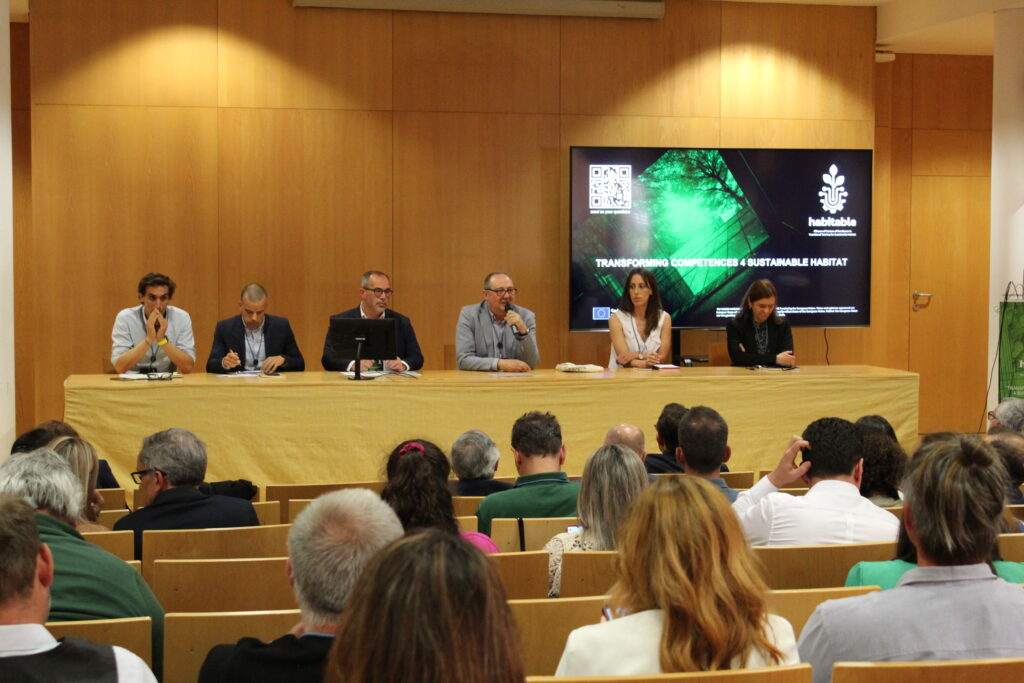
INFODEF, as a partner in the HABITABLE project, recently participated in its second meeting held in Aveiro on May 23 and 24. This European project addresses the shortage of skilled workers in digitalization and the green transition in the housing sector and aims to improve vocational training through active collaboration between institutions, local partners, and an international network of centers of excellence. It also provides a space for training and skill updates for students and professionals in the sector. The meeting began with a dissemination event titled “Transforming Skills for a Sustainable Habitat” at the University of Aveiro, co-organized by the partners Cluster Habitat Sustentável and CTCV. This event focused on the importance of green and digital skills to transform the value chain of the habitat. The event also featured a panel discussion moderated by Victor Ferreira (Cluster Habitat Sustentável), which included various experts related to the habitat sector: from the University of Coimbra, from Produtos Cerâmicos, S.A., from AICCOPN, from the University of Aveiro, and from the Ordem dos Engenheiros. Following this, the Institutional Pact for Enhancing the Circular Economy in the Central Region was presented, and Ana Neves (Erasmus+ National Agency) shared the achievements made in 2023 – the European Year of Skills. On May 24, HABITABLE partners reconvened at the University of Aveiro for the second transnational meeting of the project. Organized by Cluster Habitat Sustentável, this meeting allowed all partners to discuss the results of completed tasks, review the status of ongoing ones, and plan the initiation of new activities.